


Irregular Spelling Words Lesson Plan
There Is No K In Christmas
- Students will learn to recognize and spell sets of words in which the letters c-h are pronounced like the letter k.
- Students will become familiar with spelling patterns in which the letters c-h are pronounced like the letter k.
The sound /k/ is usually spelled with the letter c (as in cat), k (as in kitten), or c-k (as in duck). But the sound /k/ can also be spelled with the letters c-h. Although students may be familiar with the sound that the letters c-h represent in words like chop, teacher, and peach, they may not be accustomed to using the letters c-h to represent the beginning, middle, and ending sounds in words like Christmas, echo, and stomach. The song, There Is No K In Christmas familiarizes students with many words and spelling patterns where the sound of /k/ is represented by the letters c-h. Since many words with this spelling pattern are scientific or technical in nature, the song also serves to expand reading and writing vocabulary. When teaching spelling patterns like the variant c-h, it is helpful and motivation to use students’s names as examples (e.g., Zachary, Michael, Christy...)
- Sing Your Way Through Phonics Volume 3 CD, Tracks 5 and 6 (Listen to audio sample)
- Sing Your Way Through Phonics Volume 3 Mini-Charts (pp. 25-34)
- Optional: Index cards
Note: If you do not have the CD or Mini-Charts, you can still teach this irregular spelling words lesson plan using the folk tune listed on the There Is No K In Christmas Song Lyrics page. You can create your own mini-charts using the words in bold print letters in each verse of the Song Lyrics.
Find out more about Sing Your Way Through Phonics products.
Order our cost-saving Volume 3 Combo online.

- Say, “Today, we are going to practice reading and spelling words in which the sound of /k/ is spelled with the letters c-h.”
- Listen to CD Track 5 (There Is No K In Christmas), pointing to the words on the Mini-Charts as they occur in the song.
- Ask, “Why do singers in the song say, ’Yes, I do!’ when they are asked if they hear a k in Christmas?” (because Christmas sounds like it starts with k) “Is there a letter k in the word Christmas?” (no)
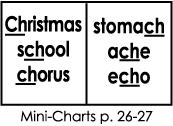
- Together, read the words on Mini-Charts pp.26-27. Ask, “What letters are used to make the sound of /k/ in each of these words?”
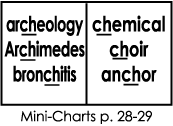
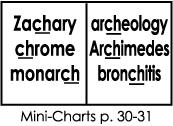
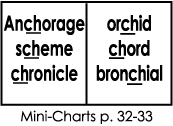
- Read the words on Mini-Charts pp.28-33 and use a dictionary or encyclopedia to look up the meanings of any unfamiliar words. Reinforce word meanings by asking, “Which words are names of people, places, or holidays and need to be capitalized?” (Christmas, Archimedes, Anchorage, Zachary) “Which words are related to the human body?” (stomach, ache, bronchitis, bronchial)
- Ask, “Which words have c-h at the beginning (Christmas, chorus, chemical, choir, chrome, chronicle), in the middle (Anchorage, scheme, orchid, bronchial, archeology, Archimedes, bronchitis), at the end (stomach, monarch)?”
- Play CD Track 5 again and ask the students to join in the singing. Allow some students to point to the Mini-Charts words as they are sung.
- Arrange letter tiles or plastic letters to form the words on each Mini-Charts page. Scramble the letters and re-form the words. See if students can do this without looking at the Mini-Charts. Check results and make corrections, if needed.
- Sing along with CD Track 5 again (There Is No K in Christmas) and allow students to point to the target sets of words on the Mini-Charts while singing.
- Practice singing There is No K in Christmas daily for a week. Then try singing the song without hearing the words, using the instrumental track (Track 6). Allow different students to point to the Mini-Charts words while singing.
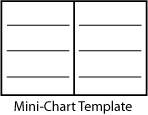
- Help students create other sets of rhyming words for the song. Make 6 copies of Mini-Chart template p.117 and allow students write in the new sets of words. Examples: Initial position—chaos, character, chlorine, chasm, Christy, cholesterol. Medial position—architect, mechanic, mocha, schedule, scholar, Michael. Final position—Bach, bellyache, earache, headache, heartache, Heimlich. Place these pages back-to-back in page protectors in a 3-ring binder. Then sing the song with the instrumental version (Track 6).
- Place Concentration with words from the song. Print Mini-Chart words on one set of index cards and their definitions on another set of cards. Make at least 6 sets of word/definition cards. Mix up the cards and lay them face down. Players turn sets of cards face up, reading the contents aloud. If a word/definition match is made, the player keeps the cards and takes another turn. If a match is not found, the cards are replaced face down and the next player takes a turn. At the end of the game, the player with the most cards wins.
- Search dictionary appendixes, books of baby names, and/or telephone books for first or last names in which the letters c-h sound like the letter k. Print results on a word wall.
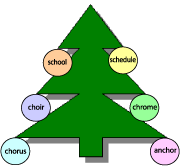
- Hang circle cut-outs on a miniature Christmas tree. On each cut-out, print a word in which the letters c-h sound like the letter k.
- Students read all the words on Mini-Charts pp.26-33 without assistance, or
- Students pass a spelling test on selected words from Mini-Charts pp.26-33